Projects
Eco-friendly Nanomaterials for Sustainable Conservation of Archaeological Wood
Principal Investigator: Aditi Singh, Dr. Sanjay Prasad Gupta
Archaeological wooden objects constitute an important component of cultural heritage, but are highly susceptible to deterioration due to ageing, moisture fluctuations, oxidation, and biological deterioration. These degradation processes weaken the wood structure, resulting in reduced mechanical strength, dimensional instability, and eventual loss of cultural significance. Conventional synthetic consolidant used for wood conservation often suffer from poor compatibility, limited reversibility, ageing-related discoloration, and environmental concerns. Therefore, there is a pressing need to develop sustainable, compatible, and reversible consolidant that can effectively strengthen deteriorated archaeological wood while adhering to modern conservation ethics.
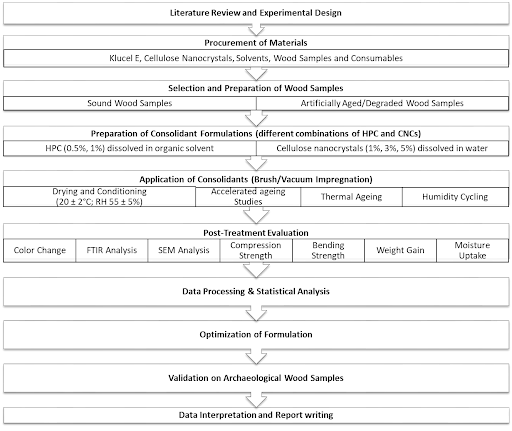
The proposed study aims to formulate environmentally friendly consolidant using commercially available Hydroxypropyl Cellulose (Klucel) reinforced with cellulose nanocrystals (CNCs). Sound as well as artificially degraded wood specimens will be selected and treated with different formulations containing varying concentrations of Klucel and CNCs. The consolidant will be applied through brush application and/or immersion, followed by conditioning and accelerated ageing under controlled thermal and humidity conditions.
Expected Outcomes
- Development of eco-friendly and environmentally sustainable wooden heritage conservation materials.
- Improved conservation methodology for archaeological wood.
- Sustainable alternative to synthetic consolidant.
- Enhanced understanding of nanocellulose-based consolidation.
- Generation of scientific data relevant to Indian heritage collections. Potential formulation guidelines for museums, archives and conservation laboratories.
- Foundation for future research on sustainable wood conservation against biological degradation.